
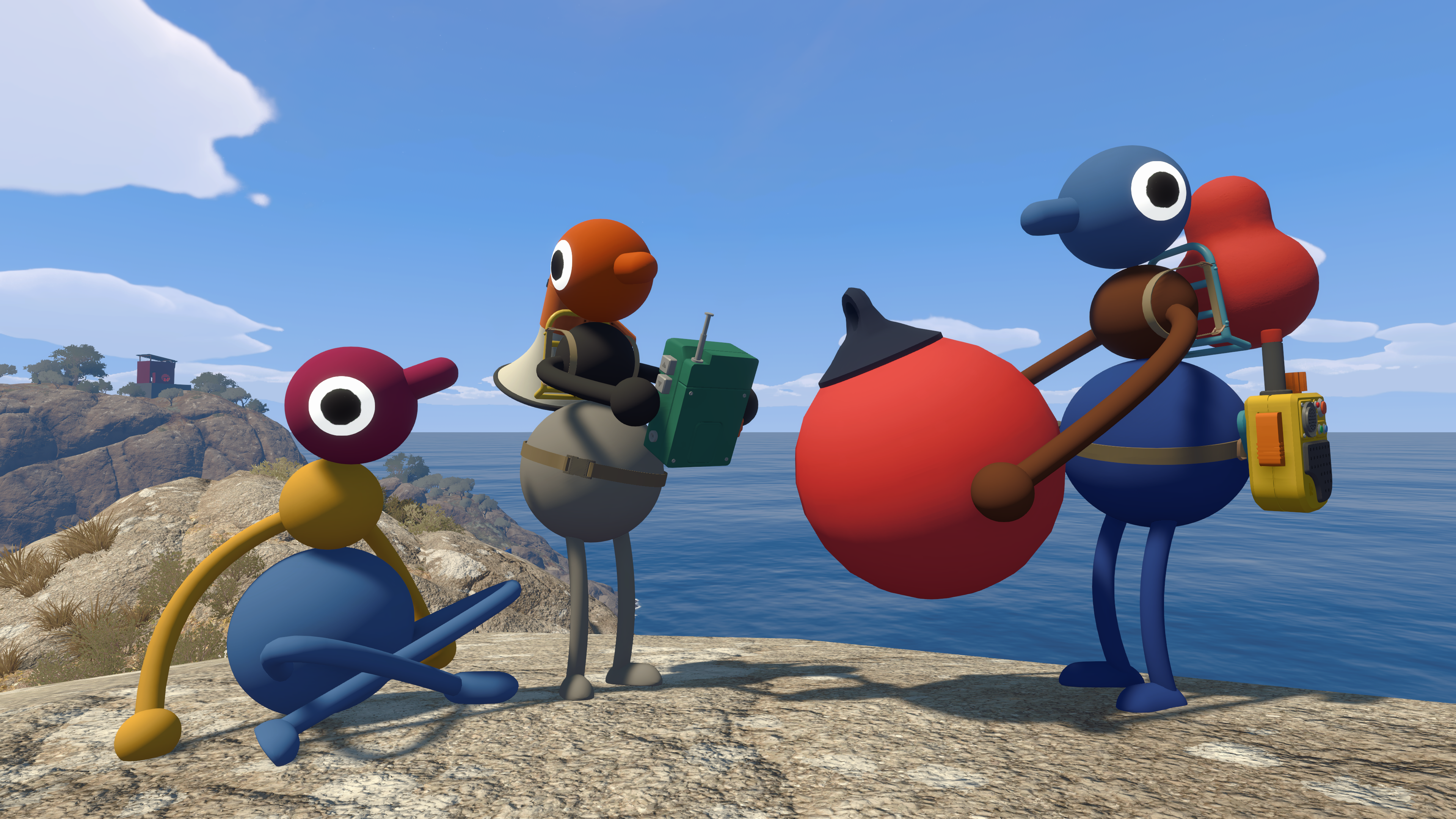
A player in *Big Walk* has a choice that most co-op games quietly remove. Keep hold of the walkie-talkie and a distant friend stays audible. Put it down and the same hands can carry the object the puzzle needs.
That trade-off comes from PC Gamer's final review, whose three-player group spent about 12 hours with the game. The reviewer found that a player could carry one object at a time. A radio extended conversation beyond local voice range, but then the radio itself occupied that carrying capacity.
Nowpinion has not conducted a hands-on review. What follows is a reconstruction from House House's current rules, official footage and independent play reports. Together they reveal a co-op game that makes the means of cooperation part of the problem.
A voice has a location
House House's official FAQ says *Big Walk* supports voice and text chat. Both are spatial. Text becomes unreadable at distance or across soundproof glass, and it can travel through walkie-talkies. The press kit says voices fade across distance, echo in corridors, muffle through walls and crackle over radios.
This is more than an audio effect. Global party chat normally lets a group treat conversation as free infrastructure: available everywhere, with no object, route or line of sight to manage. Here, location edits the message. A sentence can fade before it arrives. A wall can change speech into gesture. A radio can recover the connection, at a cost.
House House asks groups not to bypass those limits through Discord or by sitting in the same room. The request is emphatic, although the game does not punish anyone for ignoring it. The studio compares outside chat to talking during charades: remove the restriction and some situations stop making sense.
The design is not microphone-only. House House says the complete game can be played through text, with the same intentional limitations. That matters because the rule is spatial communication, not a test of who owns the loudest headset.
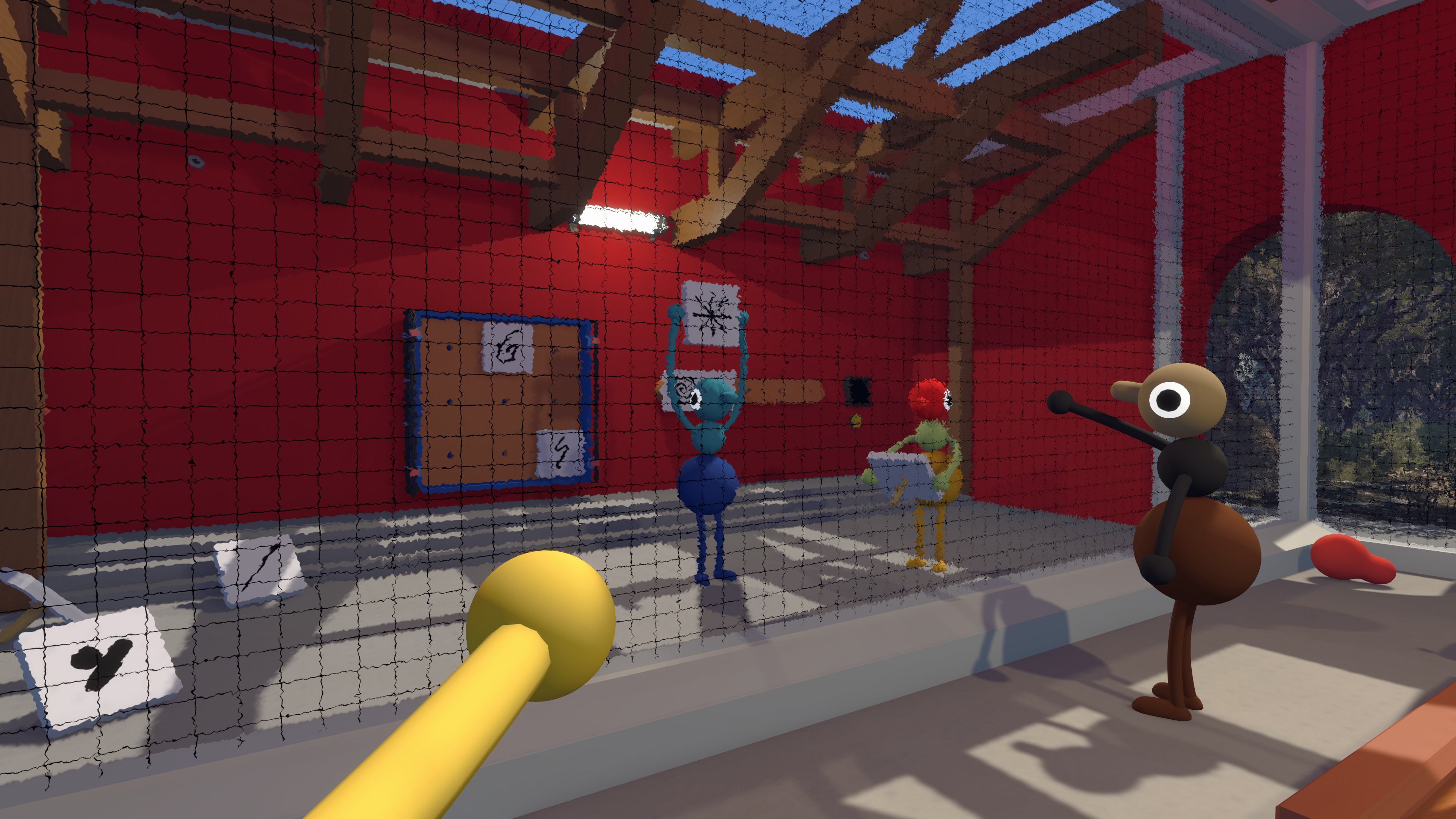
The official gameplay overview shows the advertised vocabulary: pointing arms, radios, megaphones, signs and bodies arranged around cooperative obstacles. It is edited promotional footage, so it cannot tell us whether a full session is satisfying. It does establish that talking, carrying and gesturing belong to the same toolset.
One object turns tools into choices
In PC Gamer's account, nights get dark enough that a light source can matter, signs and radios must be carried, and puzzle pieces need transport. The player can hold one object at a time before later storage systems complicate the rule.
That converts every useful tool into an allocation question. Who keeps the lamp? Who carries the radio pair? Who takes the unnamed red piece the group has decided to call a “nubbin”? A tool is not a permanent upgrade sitting in a menu. It is an object that displaces another object.
GamesRadar's separate preview supplies useful corroboration: its writer found no inventory screen and was largely limited to one held object. Game Informer's preview describes voice, text, pointing and gesture as interchangeable ways to keep a group coordinated when speech was restricted. Neither session establishes PC Gamer's exact backpack rule. Together they corroborate mechanics that require communication and objects to be carried, positioned or seen.
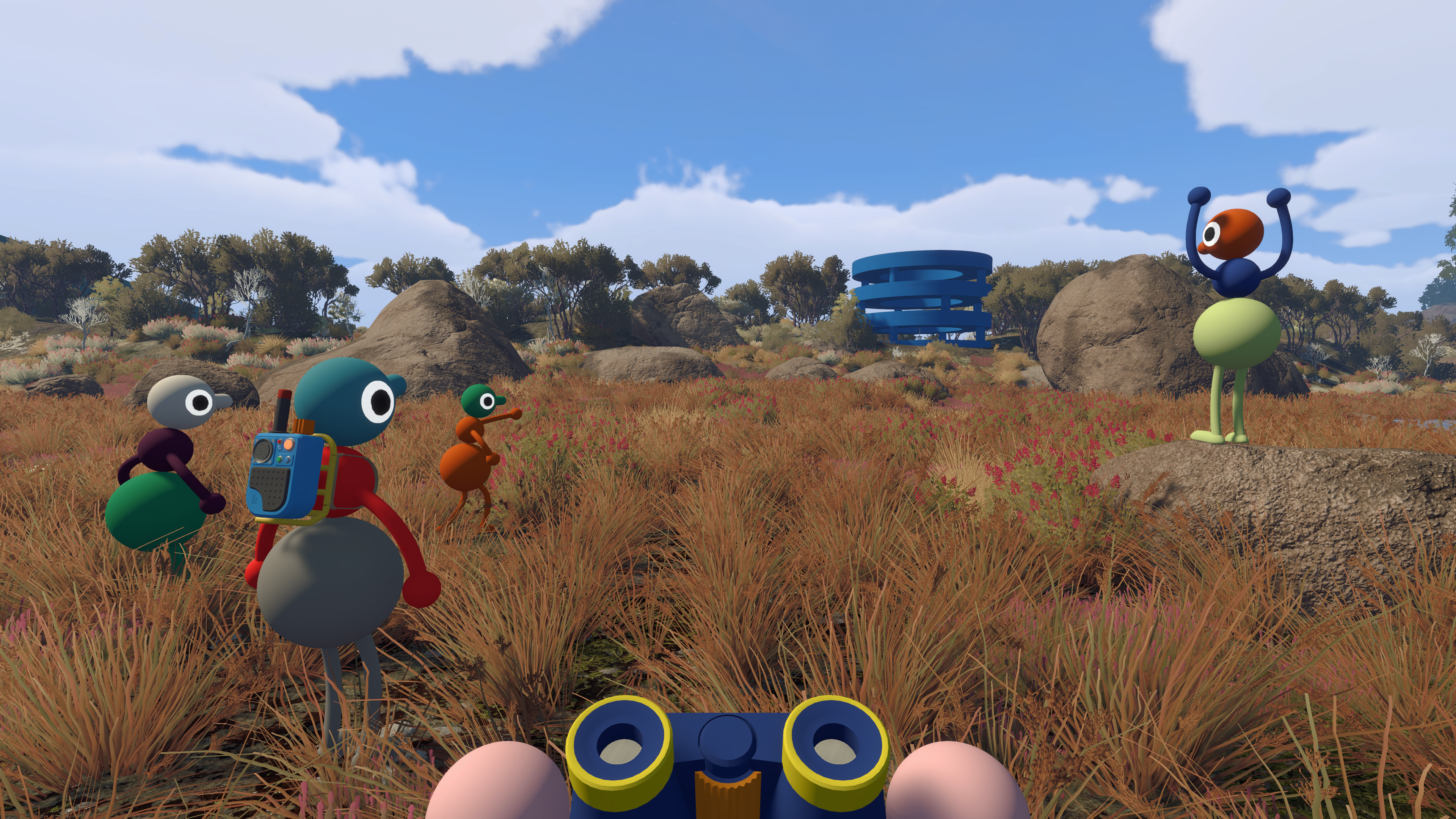
The radio-versus-clue conflict is therefore a small logistics problem with a social consequence. Keeping one person connected can delay the object everyone else needs. Carrying the object can strand a voice outside local range. The interesting unit is the group's distribution of attention and equipment, not an individual character's inventory total.
| System | Convenience removed | Compensating tool | New dependency |
|---|---|---|---|
| Local speech | Global party chat | Walkie-talkie or megaphone | Someone carries the tool |
| Text | Globally readable messages | Walkie-talkie text | Distance and barriers still apply |
| Carrying | Abstract multi-slot inventory | Backpack or later accessories | Objects displace tools in the hand |
| Storage | Private menu access | Backpack | A friend retrieves the item |
| Description | Universal labels | Gesture, signs and group shorthand | Meaning depends on shared history |
The backpack belongs to the group
Later storage does not erase that dependency. PC Gamer reports that a backpack can hold gear, but another player has to attach it and retrieve the stored object. The wearer gains capacity without gaining private access.
That is an observed mechanic from one final-code review, not language from House House's FAQ. Its effect is still clear within the reported session. Opening inventory becomes an interaction between two people. Someone must notice the request, move close enough and choose the right object.
Most game inventories collapse ownership and access into one button: if an object belongs to a character, that player can use it. *Big Walk* separates them. An item may travel with one person while another controls the moment it comes back into play.
A group invents its own language
Friction alone would produce delay. The more interesting result in PC Gamer's review is learning.
The group repeatedly encountered symbols, buttons, soundproof rooms and small puzzle objects. Later puzzles remixed those elements. Over roughly 12 hours, the players developed shorthand: a frantic arm movement could mean “wrong,” “come here,” “I found something” or the opposite, depending on shared context.
No gesture contained all that meaning by itself. History supplied it. The same three people had failed, corrected one another and reused the game's puzzle grammar often enough that an ambiguous motion became useful.
That is where restricted communication earns a function beyond novelty. When a game withholds a universal channel, the group has to build a local one. Radios and signs transmit messages; repetition teaches the players how little of a message they need.
The result should not be universalised. One review group's shorthand does not prove that every pair, twelve-player party or accessibility setup will form the same rhythm. It does show a plausible chain from repeated constraints to learned coordination, observed across a complete playthrough rather than a trailer.
Designed friction can still be faulty
The launch supplied a useful test of the thesis. Some players reported that nearby voices were too quiet even at maximum volume. That was not meaningful distance; it was an audio problem that obscured the rule.
PC Gamer's contemporaneous patch report quotes House House saying it raised players with quiet microphone setups toward the intended level. The studio did not extend the distance at which voices dropped away. It compared that distance to a character's jump height in a platform game: a specific parameter shaping what players can do.
The distinction matters. A friend fading as they walk away conveys location and creates a decision about contact. A friend being inaudible while standing beside the group conveys nothing useful. One is a constraint to reason around; the other is a failed signal.
House House's current FAQ also lists challenge skipping, full control rebinding, motion-reduction overlays and the ability to use text instead of a microphone. It warns that some challenges demand hearing or reading, speech or typing, quick reactions or fine motor control. Those concrete affordances make a stronger accessibility claim than saying the design works for everyone. The latter remains untested.
More friends change the world
*Big Walk* supports between two and 12 players, but the host chooses a two-player, three-player or four-plus version of the world. House House says some challenges change to fit that selection; the setting does not cap how many people may join.
The configuration acknowledges that a communication problem has to scale. Two people can divide only two roles. Four can relay a message, distribute objects or create extra noise. Twelve can produce a crowd, but the public evidence does not identify a best group size or prove that every challenge scales equally.
The host also holds the save, and the official FAQ describes the game as a long-form adventure intended for the same group over several sessions. That continuity gives shorthand time to accumulate. It also makes cooperation dependent on schedules and on one host returning—another practical constraint outside the puzzle design.
Put down the radio
The headline's choice is literal in one documented playthrough and useful as a model for the whole system. A group cannot treat voice, tools, storage and puzzle objects as separate conveniences. Each asks something of another player.
The radio keeps a relationship audible across distance. The clue advances the mechanism in front of the group. A backpack holds more than a pair of hands, while a friend decides when its contents return. Repeated puzzles turn those dependencies into a shared vocabulary.
Putting down the radio does not end cooperation. It exposes the next form cooperation has to take: trust that the distant friend can cope, that somebody remembers where the radio was left, and that the object now in hand is worth the silence.